
A DIFFERENT WAY TO UNDERSTAND RECURRING DIFFICULTIES
Your problem may be more than a problem to solve.
It may be a pattern to understand.
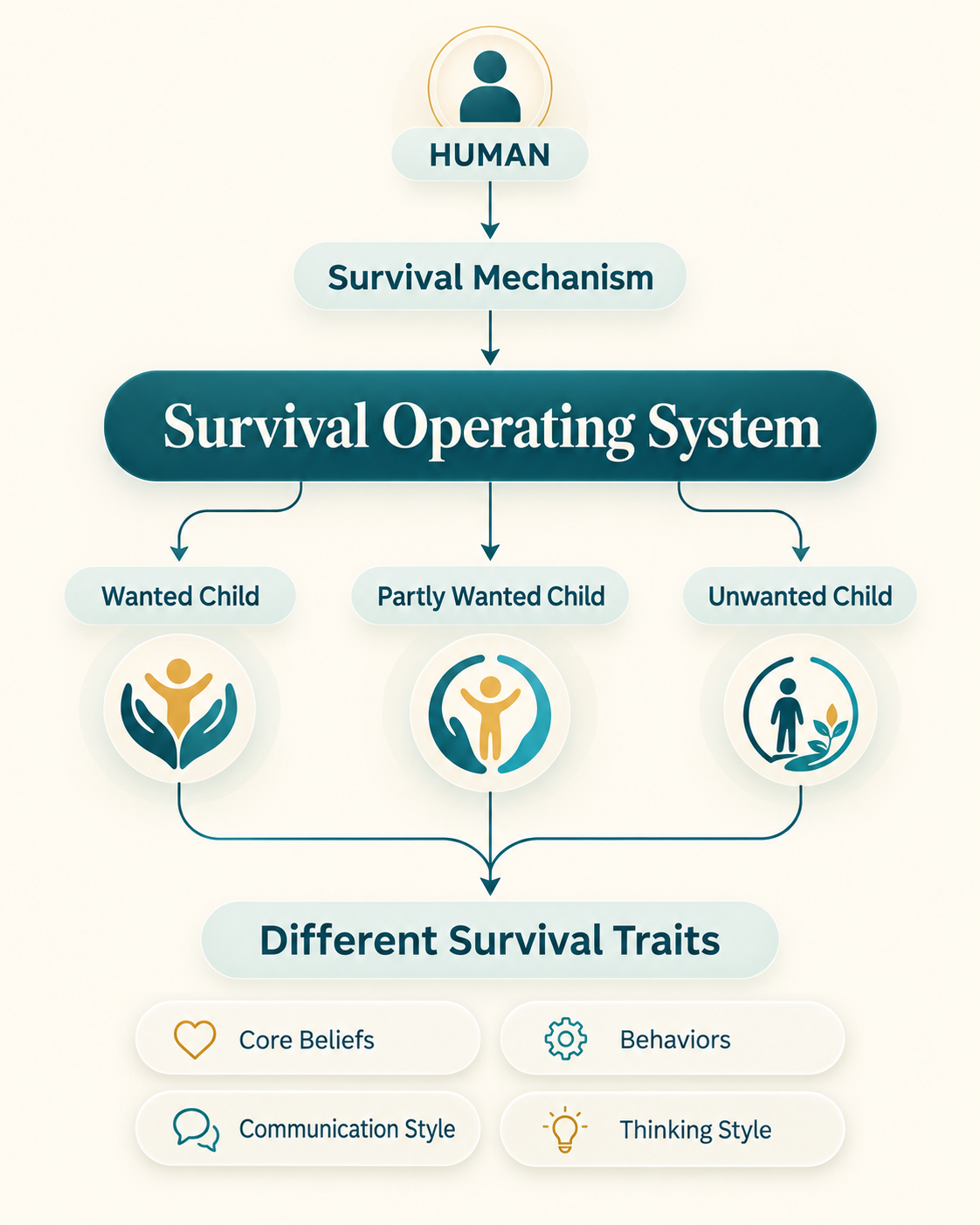
The Survival Operating System—SOS—is Lawrence Fernandes’s conceptual framework for exploring recurring patterns in emotions, beliefs, decisions, behavior, and relationships.
Therapy integrates this understanding with NLP and Clinical and Ericksonian Hypnotherapy to help you develop greater awareness and more helpful responses.
In-person in Mumbai
Online therapy
Practising since 1998
THE PROBLEM MAY BE VISIBLE. THE PATTERN MAY NOT BE.
You notice the difficulty. You may not notice what keeps repeating beneath it.
People commonly notice anxiety, emotional distress, overthinking, relationship conflict, low confidence, self-sabotage, or repeated reactions. What may be less visible are the beliefs, expectations, and protective responses operating beneath the difficulty.
SOS asks a different question: “What familiar survival pattern may be operating through this difficulty?”
VISIBLE DIFFICULTY
REPEATED THOUGHTS, HABITS & EMOTIONS
BELIEFS, EXPECTATIONS AND PROTECTIVE RESPONSES
SURVIVAL MECHANISM PATTERNS
This visual supports reflection. It does not claim that one pattern causes every psychological or emotional difficulty.
THE CONCEPT BEHIND SOS
A response that once provided safety may continue after circumstances have changed.
The Survival Operating System describes how a child may develop ways of gaining safety, acceptance, stability or a place within the family environment.
Over time, these responses may become familiar ways of interpreting situations, managing emotions, relating to other people, responding to expectations, making decisions, protecting oneself and pursuing or avoiding goals. Some responses may become strengths.
Others may create difficulties when they are automatically repeated in adult situations.
SOS does define who you are - your survival construct. It provides a lens for examining patterns that may otherwise remain invisible.
Three Survival Mechanisms. Three different ways of surviving.
Each SOS pattern contains useful strengths as well as responses that become limiting when automatically repeated. These patterns are offered as a lens for reflection, not as fixed definitions of who you are.
SOS MODEL 01
Wanted Child
The survival of approval and expectations
This pattern develops around being a desired child - valued, accepted or expected to fulfill particular roles.
Strengths
Responsibility, Discipline, Commitment, Achievement
Possible difficulties
Fear of disappointing others, Fear of mistakes & failures, Perfectionism, Dependence on approval
“How much of what you do is influenced by expectations?”
SOS MODEL 02
Partly Wanted Child
The survival of uncertainty and adaptation
This pattern develops where acceptance, attention, or emotional availability feels inconsistent.
Strengths
Patience, Resilience, Generosity, Adaptability
Possible difficulties
Tolerating unsatisfying situations, Non-assertive, Delaying personal needs, Continuing to wait for circumstances to change
“Have I learned to keep adapting while waiting for circumstances to change?”
SOS MODEL 03
Unwanted Child
The survival of persistence and establishing one’s place
This pattern develop around having to prove, defend or establish one’s right to belong.
Strengths
Persistence, Independence, Persuasion, Goal orientation
Possible difficulties
Feeling rejected or opposed, Becoming highly defensive, Conflict around control, Pursuing goals despite personal cost
“Do I repeatedly feel that I must fight, prove or establish my place?”
These three SOSs form part of Lawrence Fernandes’s Survival Mechanism Model, developed through his therapeutic experience. They provide a starting point for understanding recurring patterns while recognizing that every person’s experience is individual.
THE PATTERN MAY APPEAR IN MORE THAN ONE AREA
A Survival Mechanism may influence how you interpret and respond to life.
SURVIVAL MECHANISM PATTERNS
EMOTIONS
What feels threatening, overwhelming, helpless, or difficult to regulate?
RELATIONSHIPS
What do you expect from others, and how do you respond when expectations are unmet?
DECISIONS
Are choices influenced by approval, uncertainty, rejection or the need to prove something?
SELF-IMAGE
How much of your identity depends on roles, achievement or other people’s responses?
BEHAVIOR
Why do certain efforts repeatedly succeed, stall or become self-defeating?
GOALS
Who determines which goals need to be achieved, and by what process?
FROM PATTERN RECOGNITION TO THERAPEUTIC WORK
SOS helps identify the possible pattern. Therapy helps you work with it.
1
Recognise with SOS
Explore recurring responses, expectations, protective strategies and the situations in which the difficulty becomes active.
2
Understand with NLP
NLP may be used to explore internal language, beliefs, assumptions, mental images, emotional sequences, communication patterns and anticipated outcomes.
3
Explore with Hypnotherapy
Clinical and Ericksonian Hypnotherapy may use focused, relaxed attention to explore automatic responses, access personal resources, consider new perspectives and rehearse more helpful responses.
4
Integrate into daily life
Greater awareness may create room to recognise the familiar pattern and respond with more choice in everyday situations.
RECOGNIZE → UNDERSTAND → EXPLORE → DEVELOP → INTEGRATE
The methods used may vary according to the individual’s needs, preferences and comfort. Not every method is used in every session.
HOW THE LENSES MAY WORK TOGETHER
The presenting difficulty and the underlying pattern are explored together.
Anxiety and overthinking
SOS may explore
What feels unsafe and what protective response may be repeatedly activated.
NLP and Hypnotherapy may help address
Internal predictions, self-talk, emotional sequences, focused relaxation and alternative responses.
Relationship conflict
SOS may explore
Expectations, belonging, rejection and repeated interaction patterns.
NLP and Hypnotherapy may help address
Communication, interpretation, emotional responses and more helpful ways of relating.
Self-sabotage or low confidence
SOS may explore
How avoiding, delaying, proving or seeking approval may serve a protective purpose.
NLP and Hypnotherapy may help address
Beliefs, internal strategies, personal resources and more useful behavioural choices.
DEVELOPED THROUGH THERAPEUTIC EXPERIENCE
A framework shaped through observation of recurring patterns in therapy.
Through many years of therapeutic work, Lawrence Fernandes noticed that people experiencing different difficulties sometimes repeated familiar ways of seeking acceptance, adapting to uncertainty, or establishing their place.
These recurring observations led to the development of the three Survival Mechanism patterns—Wanted Child, Partly Wanted Child and Unwanted Child—and subsequently the broader Survival Operating System framework.
SOS brings these observations together as a practical lens for exploring how early adaptations may continue to influence beliefs, emotions, relationships, decisions and behavior in adult life.
OBSERVATION
Explore recurring responses, expectations, protective strategies and the situations in which the difficulty becomes active.
UNDERSTANDING
NLP may be used to explore internal language, beliefs, assumptions, mental images, emotional sequences, communication patterns and anticipated outcomes.
FRAMEWORK
Clinical and Ericksonian Hypnotherapy may use focused, relaxed attention to explore automatic responses, access personal resources, consider new perspectives and rehearse more helpful responses.
Every person’s experience is individual. SOS provides a starting point for exploration—not a conclusion about who someone is.
AWARENESS CAN BE A PLACE TO BEGIN
You may already know what the problem is. The next step may be understanding the pattern.
Explore whether the Survival Operating System (SOS), NLP, and Hypnotherapy may offer a helpful way of understanding what you are experiencing.